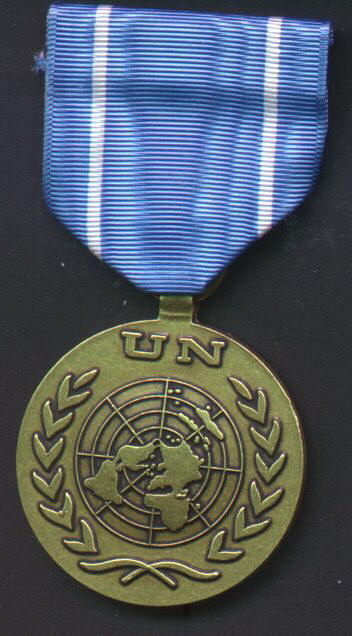
Established in June 1948 to assist the Mediator and the Truce
Commission in supervising the truce in Palestine called for by the
Security Council. Since its inception, UNTSO has performed various
tasks entrusted to it by the Security Council, including the
observation of the cease-fire in the Suez Canal area and the Golan
Heights following the Arab-Israeli war of June 1967. At present,
UNTSO assists and cooperates with UNDOF and UNIFIL in the
performance of their tasks; observer groups are stationed in Beirut
and in Cairo with liaison offices in Amman and Gaza City. UNTSO also
provided cadres of Military Observers for the initial set-up of
UNGOMAP, UNIMOG, UNIKOM and UNPROFOR.
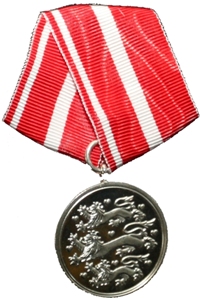
The ribbon has a UN blue background with two narrow white stripes,
the colours of the UN. Six months service is the eligibility period
for service with UNTSO.
At present, UNTSO assists and cooperates with UNDOF on
the Golan Heights in the Israel-Syria sector, and with UNIFIL in the
Israel-Lebanon sector.
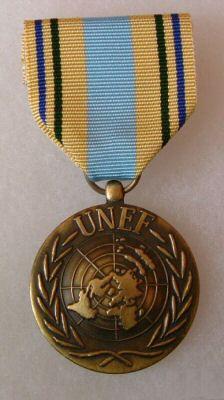
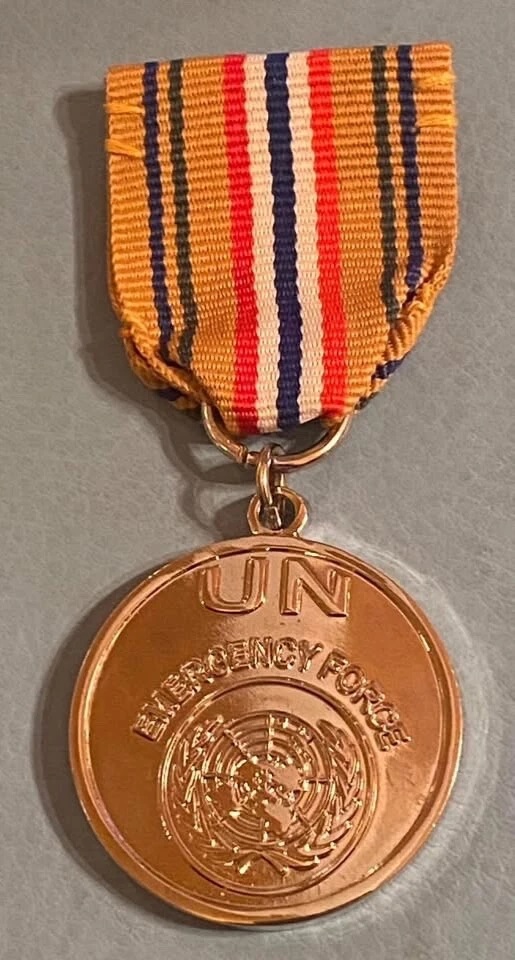
In 1956, Egypt nationalized the Suez
Canal Company and put a blockade on the international waters of the
Straits of Tiran for Israeli ships. On 29 October 1956, Israeli
forces launched an attack on Egypt and occupied Sinai and the Gaza
Strip. A few days later British and French troops landed in the Suez
Canal Zone. The UN Assembly established the
first United Nations Emergency Force (UNEF). Its main functions were
to supervise the withdrawal of the three occupying forces and, after
the withdrawal was completed, to act as a buffer between the
Egyptian and Israeli forces and to provide impartial supervision of
the ceasefire. In the event, UNEF, stationed entirely on Egyptian
territory with the consent of the Government, patrolled the
Egypt-Israel armistice demarcation line and the international
frontier to the south of the Gaza Strip and brought relative quiet
to a long-troubled area. The Canal, blocked as a result of the
conflict, was cleared by the United Nations. UNEF I was withdrawn in
May-June 1967 at the request of the Egyptian Government, which
informed the Secretary-General that it would no longer consent to
the stationing of the Force on Egyptian territory and in Gaza.
Pictures of award ceremonies
UNEF keychains
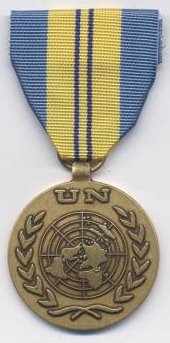
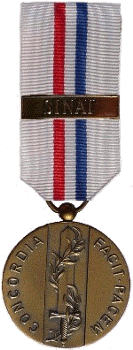
Established in October 1973 to supervise the cease-fire between
Egyptian and Israeli forces and, following the conclusion of the
agreements of 18 January 1974 and 4 September 1975, to supervise the
redeployment of Egyptian and Israeli forces and to control the
buffer zones established under those agreements. The mandate for
this Mission expired in July 1979 and the troops were withdrawn.
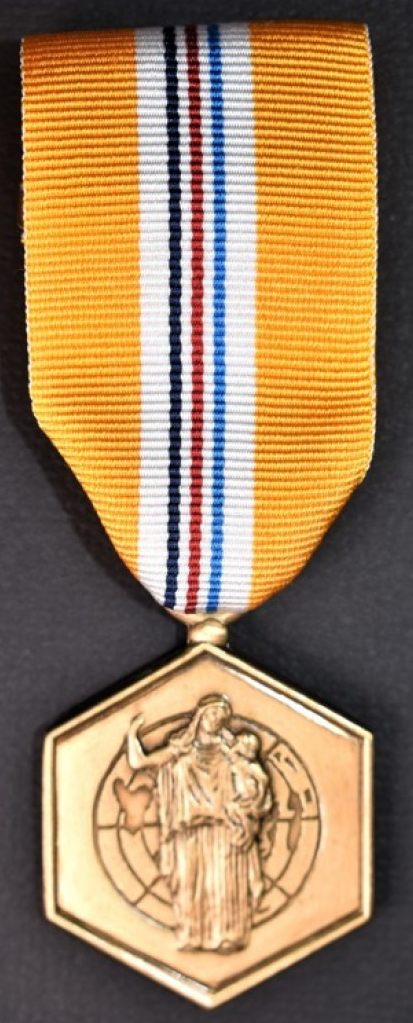
The ribbon bears a wide central band of a sand or buff colour
symbolizing the Sinai Desert with two narrow dark blue lines through
the middle, representing the Suez Canal. Two wide bars of UN blue
appear at either end. Eligibility period was 90 days of service in
the Mission.
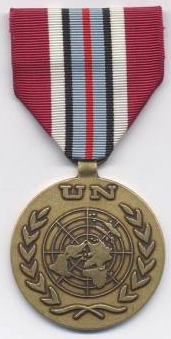
Established in June 1974 to supervise the cease-fire between Israel and Syria; to supervise the disengagement (redeployment) of Syrian and Israeli forces; and, to establish a buffer zone, as provided in the Agreement on Disengagement between Israeli and Syrian Forces of 31 May 1974. The Mission continues to perform its functions effectively with the cooperation of the parties. The ribbon contains a central stripe of UN blue with a red line down the middle representing the UN patrolled Area of Separation; two narrow stripes of black, representing the volcanic rock of the Golan region appear on either side with two narrow bands of white, symbolic of the snow on Mt. Hermon, outside these. At either end are wide bands of burgundy, symbolizing the purple haze at sunset and the native thistles of the Golan. Ninety days service is the qualifying time for award of the medal.
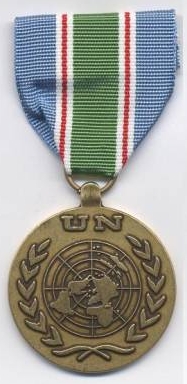
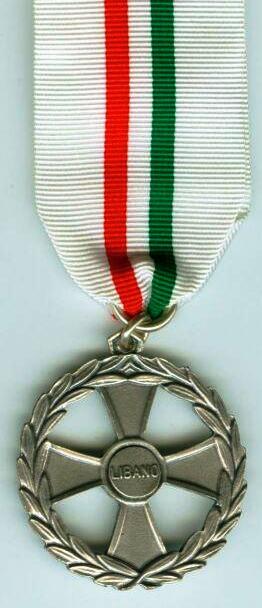
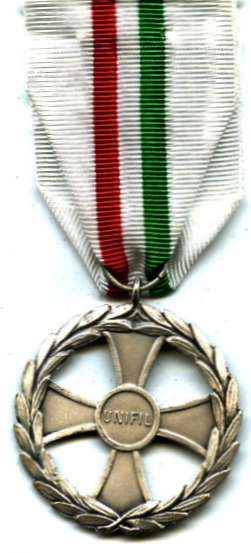
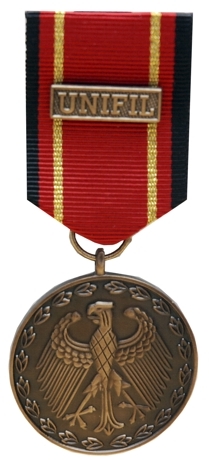
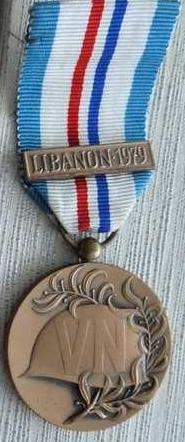
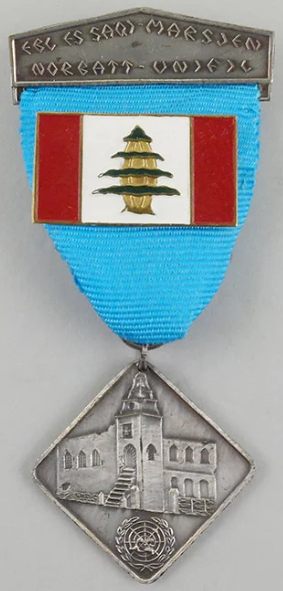
This Mission was established in March 1978 to confirm the withdrawal of
Israeli forces from southern Lebanon, to restore international peace
and security, and to assist the Government of Lebanon in ensuring
the return of its effective authority in the area. The Mission
continues to the present date.
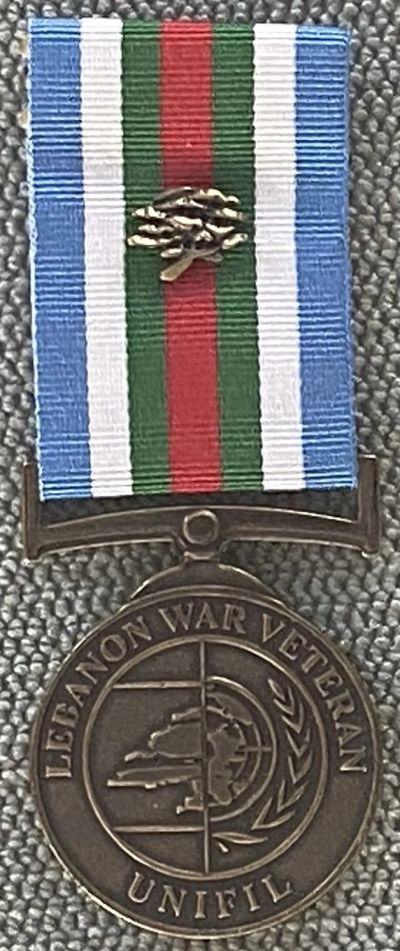
The ribbon bears three equal bands of UN colour: blue, green and UN
blue. The bands are separated by two equal sized white stripes, each
bisected by a narrow red line. The colours represent the UN and
Lebanese flags. The qualifying period of service to earn the medal
is 90 days of service in the Mission.
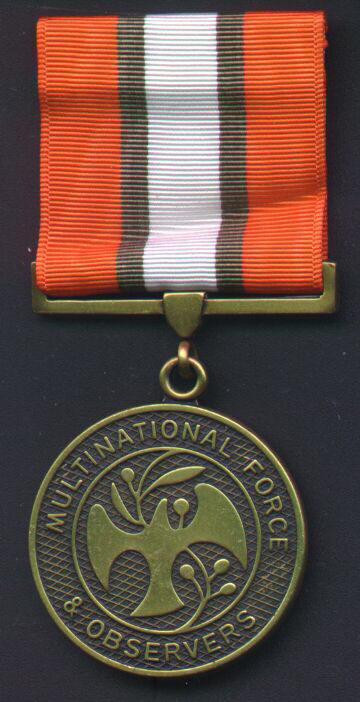
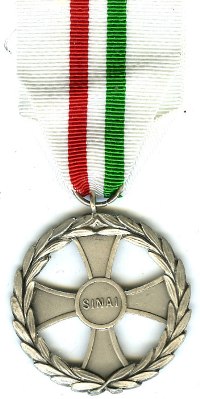
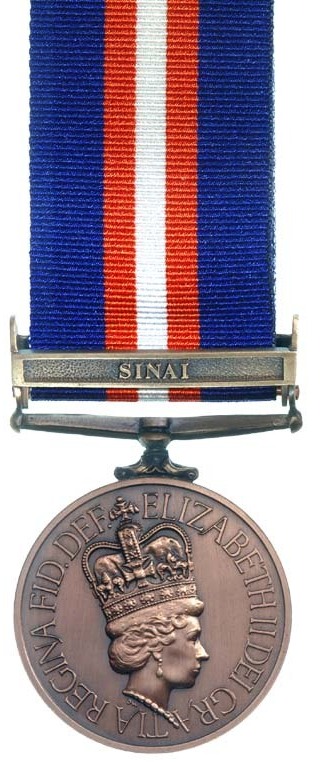
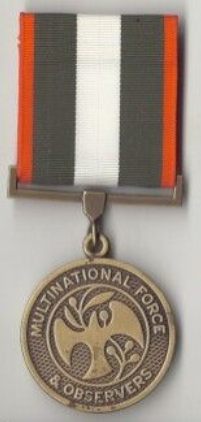
The MFO was established to monitor a neutral ceasefire zone, between Egypt and Israel, as the result of the Yom Kippur War of 1973. The MFO medal was instituted on March 24, 1982. Awarded for a term of 170 days.
Click here to find MFO Commemorative medals and challenge coins
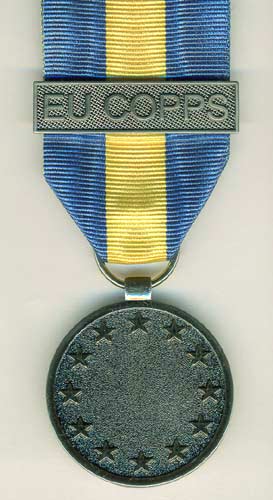
EU COPPS was established in January 2005 within the office of the EU Special Representative (EUSR) to the Middle East Process, Marc Otte. It aims at assisting the Palestinian Authority in developing a modern and effective civil police service.
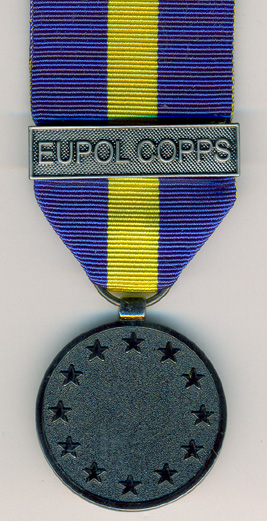
European Union Co-ordinating Office for Palestinian Police Support
EUPOL COPPS was established following an EU Council decision in November 2005, and builds on the work of the EU Co-ordination Office for Palestinian Police Support (EU COPPS), which was established in January 2005 within the office of the EU Special Representative for the Middle East Peace Process, Ambassador Marc Otte.
The operational phase started on 1 January 2006 and will have an initial duration of 3 years. The EU Police Mission for the Palestinian Territories, code-named EUPOL COPPS, has a long term reform focus and provides enhanced support to the Palestinian Authority in establishing sustainable and effective policing arrangements.
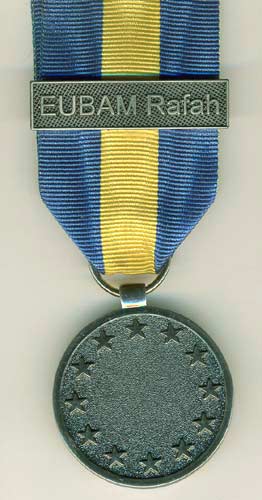
The European Union Border Assistance Mission at
the Rafah Crossing Point - code name EUBAM Rafah - was launched on
24 November 2005, to monitor the operations of the border crossing
point between the Gaza Strip and Egypt, after Israel and the
Palestinian Authority concluded an Agreement on Movement and Access
on 15 November 2005. The Council of the European Union welcomed the
Agreement and approved that the EU should undertake the third-party
role proposed.
The operational phase of the mission began on 30 November 2005. The
Rafah Crossing Point was last opened with the presence of EUBAM
monitors on 9 June 2007.
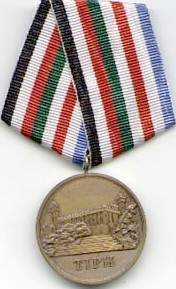
The Temporary International Presence in Hebron , abbreviated TIPH , was an international facility with civilian observers who monitored the situation in the city of Hebron in the Israeli-occupied West Bank. The observer group was supposed to promote stability in the city and contribute to the re-establishment of normal social and economic life after the massacre in 1994 and the unrest that followed in its wake. With two shorter interruptions (initially and during the Muhammad caricature tour), the involvement lasted for twenty years. TIPH's mandate was unilaterally terminated by Israel in January 2019.