@ Igor Ostapenko
@ Igor Ostapenko
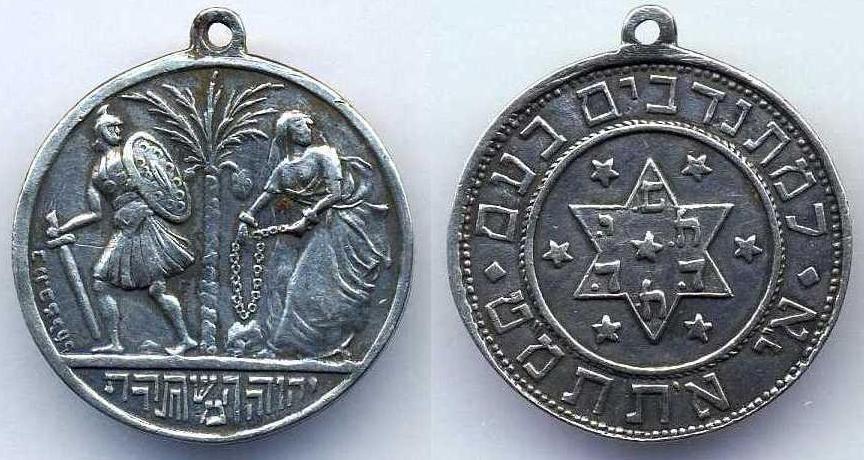
Extremely Rare "Eretz Israel Volunteers Medal",
1918: issued to Jewish volunteers from Palestine-Eretz Israel on the
eve of their departure to join the Jewish Battalions (i.e. the Jewish
Legion; specifically the 40th Royal Fusiliers), which fought in
Palestine under General Allenby.
The medal depicts "Bat Zion" (Daughter of Zion - symbolic of the Jewish
People) freeing herself from Roman captivity, with the legend beneath
"Judea the Freed", and the maker-mark of "Bezalel" on the obverse, and a
Kabbalistic symbol surmounted by the legend "For the Volunteers of the
Nation in Eretz Israel" and the Hebrew date 1849 (i.e. 1912 BC) on the
reverse - probably a reference to the birth date of Rebecca, daughter of
Bethuel ibn Nahor, wife of the Prophet Isaac, and mother of Jacob (ref.
Esau, and Rachel, Leah and Laban).
Although seldom encountered and not a standard catalogued item, there
is a very precise account of its issue in Ever HaDeni's book "A Nation
in its Wars" (publ. 1948; pg. 104):
"In mid June-July [month of Tammuz, 1918] there was organized a large
assembly at the ruins of the home of Rabbi Yehuda the Chasid in
Jerusalem, with the participation of James Rothschild and his escort
Lieutenant Lipsy. The son of the Baron [Rothschild] delivered a speech
on the importance of the Hebrew [i.e Jewish] Battalion which would fight
shoulder to shoulder with the British. After him, spoke Lipsy and the
Rabbi Harelp, who said: "Who is the G-d fearing and good hearted man who
will go forth and return to his home."
The wise man Laniado gave support to his son the volunteer and at the
same time people distributed fliers sponsored by the Battalion committee
with the cry "Long Live the Hebrew Battalion". Students of the seminar
answered the call and from sixty men, close to 40 enlisted as did 17
year-olds and teachers from the Boys' School. Fathers took with them
their sons; mothers sent their children to enlist and brides sent their
husbands. The Yemenite community sent upwards of 50 people (from
Jerusalem); and volunteers from the religious Yeshivot also came.
On 4 July 1918 in the morning, after the departure ceremony, the
volunteers were issued a "Bezalel" made medal on which was stamped, "Bat
Zion Who Broke the Chains of Exile" - and depicting the Roman running
away from her. At 12 o'clock the volunteers set out by train,
accompanied by a crowd of 10,000 people."
The significance of this medal is that it represents the first military
medal ever issued by Jews for Jews, commemorating military service for
Israel. The British conquered Jerusalem in December 1917, although
northern and southern Palestine were still in Ottoman-Turkish hands at
this time.
There was no central government and so the issuance of this medal can be
seen as "official" even if only within the Jewish community of
Palestine. The Jewish Battalions (the "Jewish Legion"; 38th-40th Royal
Fusiliers) succeeded an earlier formation called the "Zion Mule Corps"
which served in Gallipoli, in 1915; although the Mule Corps by default
faced front-line action, the Jewish Legion was technically the first
all-Jewish combat formation in 2000 years.
Source of above description:Historama
The medal has a weight of about 6 gram.